Listen to Samples
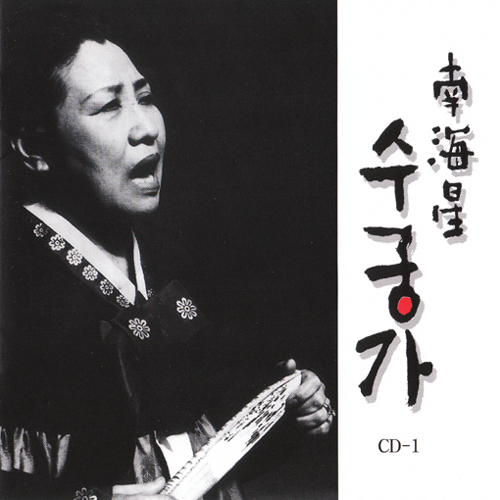
This album leads to the wonderful world of Pansori, a traditional Korean art form combining storytelling and music, through the magnificent performance of a master Pansori singer Nam Hae-Sung. She particularly presents Sugung-ga (the song of the underwater palace), one of five extant Pansoris.
Sugung-ga is based on the story of the Dragon King of the Southern Sea, a turtle, and a wily rabbit. The king is suffering from an ailment that can be cured only with the liver of a rabbit. The King thereupon summons all the ministers to look for the liver of a rabbit on the ground. The turtle volunteers his service to journey to a forest and return with a rabbit. In Sugung-ga animals satirize beings, thus showing the world as it really is. From the expression of the various aspects of human nature through the music, the listener is able to hear the composer's consciousness and appreciate the perfection of his work.
The story is set in three different places: from the underwater palace to land, to the palace again and then back to land. The most beautiful music occurs in the third scene change where the hero, a rabbit, deceives the Dragon King and escapes. This part begins with the rabbit yelling, "Open my stomach?" (to remove his liver, which was thought to have medical qualities) to his cursing the turtle after arriving back on land. This part, in which the rabbit calls the turtle names, is made up of the unique musical idioms of Kyeongdurum, which is also called Kyeong-jo, refers to the supposed singing style of Seoul.
Saturday, April 19, 2008
Pansori Sugung-ga Part I by Nam Hae-Sung

Wednesday, April 2, 2008
Pansori (Korean Opera) Choonhyang-ga by Kim So-Hee
Listen to Samples
This album leads to the wonderful world of Pansori, a traditional Korean art form combining storytelling and music, through the magnificent performance of legendary Pansori singer Kim So-Hee. She particularly presents Choonhyang-ga (the love story between Choonhyang, the daughter of a kisaeng entertainer, and Yi Mong-Ryong, the son of a magistrate), one of five extant Pansoris.
Among the extant Pansori classics Choonhyang-ga is not only known for its outstanding artistic qualities, it is also performed most frequently. If we were to connect the musical and dramatic structure and examine the entire piece, the four distinct portions are discernable. Choonhyang's falling in love, the lover's separation, and her trials, and rescue. Despite the fact that Choonhyang does have a "happy ending," each school of this particular Pansori shares in common tragic portions of musical intensity. The tragic elements begin with the separation of the lovers and come to a climax in Choonhyang's imprisonment. However, Choonhyang's separation from her lover is generally considered to be the most detailed and sophisticated musical passage in the entire piece.
According to Kim Myong-Hwan (outstanding drummer whose talent merited the designation as an Intangible Cultural Asset), Myongchang (prominent singers), in order to sing these tragic passage, would bolster their strength by surreptitiously tightening the bands that served as belts for their clothing. After they finished these portions, they would loosen their bands. They understood the importance of these passages with the purpose being to give additional support to their stomach muscles so that they could put their entire might into the presentation.
There was another reason that Pansori master put so much emphasis on the tragedy in their performances. From the end of the 19th century on, audiences have exhibited a marked preference for tragedy over comedy. This phenomenon also appears to be true in western opera. One may surmise that human beings share this interest in the aesthetics of tragedy in common.
Pansori is one genre of traditional Korean performing arts. In Pansori, one singer, accompanied by a drummer, presents a long story in the form of a dramatic narrative generally sung with spoken commentary interspersed. The stories do not lack for dramatic climaxes. In fact these "high points" serve to give the stories their dramatic structure and to maintain audience interest.
The audience can enjoy the combinations of rhythm, beat, and phrasing and intonation of vocal in Pansori. Although the ways of arrangement are basically established in Pansori performance, they feel a kind of spontaneity or improvisation.
Of the 12 lyric dramas, currently there are only five Pansoris still being performed which include Sugung-ga (the journey of the rabbit and turtle to the underwater kingdom), Simcheong-ga (the story of Simcheong and her blind father), Jeokbyeok-ga (the story of the big battle at Red Cliff), Choonhyang-ga (the love story between Chunhyang, the daughter of a kisaeng entertainer, and Yi Mongryong, the son of a magistrate), and Heungbo-ga (the story of two brothers, Heungbo and Nolbo). "Ga" means a "song." Even the shortest one lasts 4 hours and the longest one lasts as long as 8 hours. The singer continues to perform without intermission.
The singer must portray the personalities of all the characters in the story through Chang (song), Aniri (spoken song), and Ballim (gesture). And the drummer joins in with Chuimsae which is decorative vocal adorations and sounds of encouragement given to the singer.

Pansori Simcheong-ga by Park Dong-Jin
Listen to Samples
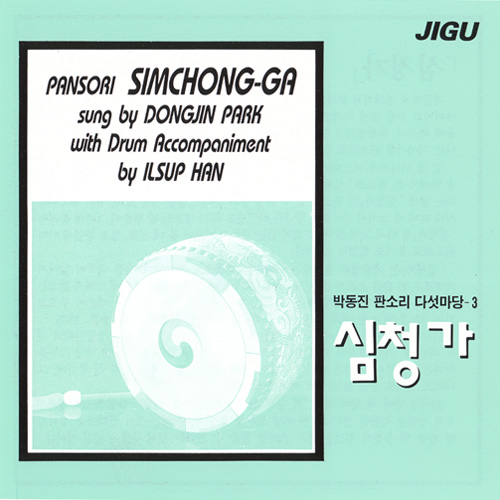
This album leads to the wonderful world of Pansori, a traditional Korean art form combining storytelling and music, through the magnificent performance of Park Dong-Jin. He particularly presents Shimchong-ga (the story of simcheong and her blind father), one of five extant Pansoris.
Pansori is one genre of traditional Korean performing arts. In Pansori, one singer, accompanied by a drummer, presents a long story in the form of a dramatic narrative generally sung with spoken commentary interspersed. The stories do not lack for dramatic climaxes. In fact these "high points" serve to give the stories their dramatic structure and to maintain audience interest.
The audience can enjoy the combinations of rhythm, beat, and phrasing and intonation of vocal in Pansori. Although the ways of arrangement are basically established in Pansori performance, they feel a kind of spontaneity or improvisation.
Of the 12 lyric dramas, currently there are only five Pansoris still being performed which include Sugung-ga (the journey of the rabbit and turtle to the underwater kingdom), Simcheong-ga (the story of Simcheong and her blind father), Jeokbyeok-ga (the story of the big battle at Red Cliff), Choonhyang-ga (the love story between Chunhyang, the daughter of a kisaeng entertainer, and Yi Mongryong, the son of a magistrate), and Heungbo-ga (the story of two brothers, Heungbo and Nolbo). "Ga" means a "song." Even the shortest one lasts 4 hours and the longest one lasts as long as 8 hours. The singer continues to perform without intermission.
The singer must portray the personalities of all the characters in the story through Chang (song), Aniri (spoken song), and Ballim (gesture). And the drummer joins in with Chuimsae which is decorative vocal adorations and sounds of encouragement given to the singer.
Simcheong-ga is the most tragic of the five extant Pansoris. Within the dramatic framework Simcheong is contrasted by the comic relief provided by Ppaengdogomi and a happy ending. Structurally the story falls into three parts: Shimcheong in childhood, as a young girl, and reincarnated as a queen. The second portion is the most outstanding musically; from the point where Shimcheong goes to Minister Chang's house to the point when she is sold to sailors and throw herself into the sea.
Once Simcheong is ready to die, she does not lament her tragic fate. On the contrary, all of her songs become prayers for her blind father. This draws an even more emotional reaction from the audience. Simcheong-ga has the tragic climax realized from the point where Simcheong follows the sailors to the scene where Simcheong throw herself into the sea. Simcheong-ga has all the technical musical idioms of Pansori, so it has become a favorite among singers while been also acknowledged as the most difficult passage in all of Pansoris.
Pansori Jeokbyeok-ga Part I by Kim Il-Gu
Listen to Samples
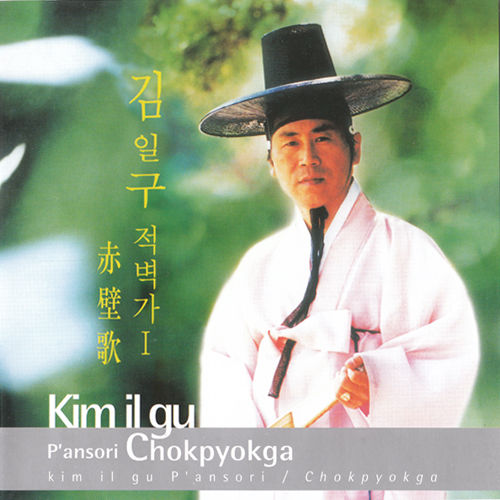
This album provides Pansori lovers with a great opportunity to relish a fine Dongpyeonje style work, Jeokbyeok-ga (the story of the big battle at Red Cliff) which is marked by powerful masculine tunes and exuberant liveliness. Jeokbyeok-ga is regarded as the most important work of the Dongpyeonje Pansori School and the most difficult Pansori work full of high-pitched tones that require extraordinary talents and many years of hard exercises.
Unlike the other four Pansori classics which are re-creations of certain legends, Jeokbyeok-ga is based on a novel. It is a battle story taken from the Chinese historical novel San-kuo-chih-yen-i. It goes without saying that the novel was reinterpreted and dramatized in the process of being set to music. The dramatic climax of the piece is Jeokbyeok Daejeon (fierce battle at the red cliff). This part is full of humor and releases the tension felt in anticipation of the fierce scene of the battlefield. The Jangseung Taryeong (song of the totem pole), which the original novel doesn't have, displays the beauty of Pansori, bringing the effect of dramatization into full play.
From the scene where Gongmyeong prays for rain to where Jaryong horrifies So Song and Chong Pong by shooting arrows is considered to be the climax of Jeokbyeok-ga. In this portion, Jajinmori Jangdan (a fast compound meter cycle) is harmonized with the way the words are linked.