
View More Pictures
This celadon porcelain incense burner is a reproduction of the great 12th century incense burner listed as Korea's National Treasure 95. The work exhibits an openwork global lid and the body of chrysanthemum petals laid upon a circular base supported by three rabbits, The lid, an openwork globe embellished with the chilbo ("seven treasures") pattern and designed to let incense smoke out, is in perfect harmony and stability with the base of six petals supported by three rabbits.
Korean celadon pottery is renowned the world over for its exquisite inlaid designs, voluminous form, elegantly-curved lines and mysterious color, the color of the sky after a rainstorm during an autumn afternoon.
Wednesday, April 2, 2008
Celadon Porcelain Incense Burner with Openwork Chilbo Lid
.jpg)

Celadon Porcelain Green Pottery Ceramic Duck Figurine
View More Pictures
This exquisite celadon pottery vessel is inspired from a duck with a lotus spray in her mouth. The spout from which water is dropped onto an inkstone is at the cut end of the lotus stalk while the hole from which it is filled with water is at the back decorated with lotus buds and leaves. The attractive curve of the breast and the delightful soaring line from the tail to the bill help create a form that is both dynamic and static.
Korean celadon pottery is renowned the world over since Goryeo Dynasty (918-1392) for its exquisite inlaid designs, voluminous form, elegantly-curved lines and mysterious color, the color of the sky after a rainstorm during an autumn afternoon.
.jpg)
Blue and White Porcelain Plate with Floral and Arabesque Design
View More Pictures
This magnificent plate is a reproduction of the blue and white porcelain plate sold at a record 3.08 million US dollars at the Christie auction house in New York in April, 1994. The plate is characterized by six bosanghwa blossoms (the imaginary Buddhist flower) in full bloom surrounded by vines and a wave band along the rim. The lavish ornamentation might lead one to compare the plate with Chinese blue and white porcelain ware, but the serene brush strokes reveal that it is a work from the tradition of Joseon (1392-1910) ceramic art.
.jpg)
Celadon Ceramic Tea Pot in a Peach Shape
View More Pictures
This celadon ceramic tea pot exhibits the peach branches and leaves design carved in relief with the attractive jade blue glaze that bestowed Koryeo celadon with a worldwide reputation. The scent, color and taste of any tea treated by this tea set will be enhanced. In the Eastern world since ancient times, the peach has been thought of as the fruit of paradise, a symbol of long life, and a fruit with magical power that drives out devils and diseases.
.jpg)
Set of 2 Celadon Ceramic Coffee Cups and Saucers
View More Pictures
A fantastic floral motif exhibiting attractive curved lines is used to decorate these celadon porcelain coffee cups and saucers. The items are further embellished with chrysanthemum designs created by the traditional inlaying technique as well as with dragon heads forming the handle. One of the "four noble beings" (sagunja) symbolizing fidelity and loyalty, the chrysanthemum has been one of the most favorite subjects used for adorning craftworks as it blooms until late autumn, thus overcoming the frost.
.jpg)
Celadon Porcelain Table Lamp with Inlaid Black Peony
View More Pictures
The elegant beauty of a Goryeo Dynasty (918-1392) celadon porcelain prunus vase has been successfully revived here as the base for a table lamp. On this delightful porcelain vase, the black inlaid peony design covers the surface wholly (instead of partly, which is the traditional method), leaving the original celadon background color to peak through the pattern. The jade blue body decorated with a design of black slip inlaying helps create a romantic atmosphere.

Paper Table Lamp Shade with Five Windflower Buds
View More Pictures
This table lamp consists of five lights covered with hanji shades in the shape of windflower buds. Each lamp is connected to a power source with a flexible cord that can be bent according to the user's need and desire. The frame and base of the lamp is also made of hanji and is dyed with a natural pigment giving it a wooden color. There is a button under the lamp so that the user can choose from three levels of brightness.
Produced after an arduous, time-consuming manufacturing process made only by hand, hanji, Korean mulberry paper, is an amazingly durable and versatile material for all kinds of arts and crafts. When used for a lampshade, hanji helps produce a beautiful, long-lasting lighting accessory for the home, radiating soft and comforting natural light to soothe the body and mind, tired from busy urban life.
.jpg)
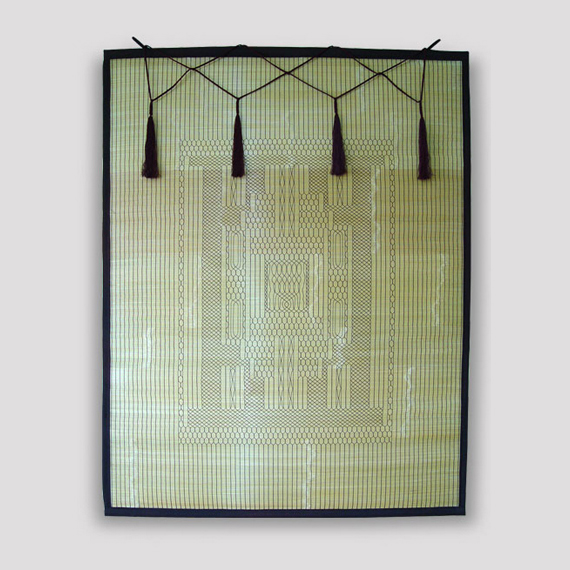
Bamboo Blind with Red Threads and Tortoise Motif
View More Pictures
This exquisite traditional Korean bamboo blind is made with fine bamboo strips less than 1mm thick, often called 'bamboo threads,' which require extraordinary skill to produce. A normal-size blind entails a number of amazing figures: 2,500 bamboo strips; corresponding to approximately 100 bamboo canes; more than 300,000 hand movements; and about three or four months in order to complete one single blind.
The tortoise motif is exquisitely woven with red threads into the blind. The fine bamboo strips and delicate thread weaving are unique features of Korean bamboo blinds.
By using this Korean bamboo screen, a material so magnificently woven that it is often described as bamboo silk, one can delight in the incredibly unique and serene ambiance of the dim outside view seen through the blind, the cool shade inside the house provided by the blind and the beautiful rhythmic movements of the tassel pendants that gently move in the breeze.
Folding Paper Bamboo Fan with Geumgangsan Mountain Painting
View More Pictures
Geumgangsan, or 'Diamond Mountain,' is one of the most famous mountains in Korea, known for its fascinating rocky peaks and valleys. The painting on the paper of this fan exhibits a peaceful autumnal scene and serene mood of a temple surrounded by rocks, pine forests and a stream flowing through a valley. The intricate pyrography bat design engraved on the bamboo ribs create a wonderful harmony with the beautiful lines made by the wide breadth of the unfolded fan's outline and the attractive three-dimensional creases of the paper arranged neatly.
The main material of hapjukseon, bamboo that has grown for three to four years without any flaw on its skin, is prepared by harvesting it during the winter. The two edge ribs of a fan should be made by using thicker bamboo strips with close joints. A fine hapjukseon fits beautifully in the hand and the flexibility of the bamboo ribs creates a wonderfully pleasant breeze, neither too strong nor too weak. In fact, the secret is hidden in the glue used to apply the mulberry paper onto the bamboo ribs. Made from the air bladder of a type of fish called a croaker, this unique fish glue is the same adhesive used for many traditional craftworks of Korea, including mother-of-pearl objects, furniture and bows and arrows. Only when this fish glue is used, a hapsukseon can attain the optimum pliability and strength that it needs.
Korean mulberry paper called hanji is extremely light and strong, and maintains its original color and shape even after a millennium. Featuring glossiness, softness, and a high capacity for upholding warmth and ventilation, the paper has been considered as the ideal material for windows, doors and walls.
.jpg)
Cloisonne Enamel Fine Silver Vase with Long Life Emblems Design
View More Pictures
This unique silver vase is brilliantly decorated with fine cloisonne 10 creatures of longevity (sipjangsaeng) design whose details outlined in silver wires. Each design is nicely created by delicately inlaying translucent enamels into the silver wire designs on the attractively embossed silver ground. The unique form of this vase is conceived from one of the greatest masterpieces of Koryo (918-1392) celadon prunus vase which is renowned the world over for its exquisite inlaid designs, voluminous form, elegantly-curved lines and mysterious color.
The sipjangsaeng, 10 creatures that ancient Koreans, influenced by the Taoist philosophy, believed were created to enjoy eternal youth: sun, stone, water, cloud, pine tree, deer, bulnocho ('herb of eternal youth'), turtle, crane, and peach. In the Eastern world since ancient times, the peach has been thought of as the fruit of paradise, a symbol of long life, and a fruit with magical power that drives out devils and diseases.
.jpg)
Macrame Wall Hanging Tassels with Fine Silver Cloisonne
View More Pictures
This unique decorative hanging exhibits the beauty of Korean macrame and cloisonne. The central piece of this hanging is a beautifully cloisonne enameled fine silver butterfly, a symbol of free love and happiness that has been used to decorate ladies' fashion or home accessories.
Unlike macrame, the Western knotting art that makes two-dimensional works, Korean macrame (maedeup) creates an enigmatic elegance of balance with finely wrought three-dimensional patterns made from a single string. Korean macrame is characterized by the beauty achieved by the trinitarian union of string (kkeunmok), knotting (maedeup) and tassel (sul). The main part of a maedeup piece knotted with two strands into various organic symmetrical patterns and shapes; and a tassel at the end freely hanging down creates the final touch to highlight the colors and patterns of the entire work.
The distinctive and elaborate feature of Korean tassel making, is weaving the design of auspicious Chinese characters, such as Su ('Long Life') and Bok ('Fortune'), into the head with chords. The bottom end of each chord freely hanging down also displays a special finishing touch: all the chords' ends are twisted, rather than cut, so that they are round, thus, embodying additional volume and beauty. The trinity of this work establishes perfect harmony with a delightful cloisonne silver ornament. This kind of macrame works called Norigae with a cloisonne ornament or various jewels has been used as a customary fashion item worn on the breast tie or the waist of hanbok, the traditional Korean dress.
.jpg)
Wall Hanging Scroll Korean Folk Dragon Painting
View More Pictures
This unique hanging scroll exhibits a perfect reproduction of Joseon dynasty (1392-1910) folk painting called Minhwa. This particular work depicts an imaginary scene of a dragon in the depths of the clouds rising from the sea’s surface. The forceful movements of the animal are captured so vividly that he looks as if he will break out of this hanging scroll.
The dragon is an imaginary animal believed to rule the sky and the sea, controlling rain, clouds, lightening and water. Also used as a symbol of kingship, the dragon is revered in many Asian countries as a sacred animal that brings fortune and expels evil forces.
The most remarkable characteristics of Korean folk paintings are their dynamic composition, the use of bold colors and simplified patterns, and the energetic and whimsical visualization of their forms, without much concern for reality. Because of these unique features Minhwa is both studied and cherished around the world.
.jpg)
With Mind and Music by DAMSA
Listen to Samples
This is DAMSA's first release in 2007. This album presents original pieces of music played with Korean traditional instruments perfectly harmonized with electric piano, synthesizer, handsonic and various world percussion instruments including djembe. The pieces include the sound of Daegeum (Korean bamboo flute) and an electric piano joined by the thick timbre of a flute creating a dreamy melody, a cantilena melody of Sogeum (small Korean bamboo flute), a simple loop of harmony and rhythm improvised by seven members.
.jpg)
Seodo Minyo - Korea's Northwestern Area Folk Songs
Listen to Samples
This album presents the most famous Seodo Minyo pieces by Kim Gwang-Sook's consummate performance. Minyo, Korean folk songs, is broadly classified into three types according to region, namely, Gyeonggi, Namdo and Seodo Minyo. Gyeonggi Minyo is traditionally popular in the central area around Seoul, while Namdo Minyo in the southern area around Jeolla-do and Seodo Minyo in the northwestern area (present-day North Korea) situated around Pyeongan-do and Hwanghae do.
Gyeonggi minyo is generally characterized by a lilting tempo and cheerful mood. As the music progresses, one feels happy and uplifted. Namdo Minyo has a relatively slow tempo and a crude, dark timbre. It's sharply alternating melody gives one the sense of deep, inward pathos. The Seodo Minyo is characterized by high clear nasal tones and fine vibrato, which combine to produce not only intense feeling of lament and sorrow, but also carry the power to express the joy and happiness in everyday life. In contrast with Gyeonggi Minyo, it has a slow tempo and pure, tranquil feeling reminiscent of a cool autumn sky.
.jpg)
Pansori (Korean Opera) Choonhyang-ga by Kim So-Hee
Listen to Samples
This album leads to the wonderful world of Pansori, a traditional Korean art form combining storytelling and music, through the magnificent performance of legendary Pansori singer Kim So-Hee. She particularly presents Choonhyang-ga (the love story between Choonhyang, the daughter of a kisaeng entertainer, and Yi Mong-Ryong, the son of a magistrate), one of five extant Pansoris.
Among the extant Pansori classics Choonhyang-ga is not only known for its outstanding artistic qualities, it is also performed most frequently. If we were to connect the musical and dramatic structure and examine the entire piece, the four distinct portions are discernable. Choonhyang's falling in love, the lover's separation, and her trials, and rescue. Despite the fact that Choonhyang does have a "happy ending," each school of this particular Pansori shares in common tragic portions of musical intensity. The tragic elements begin with the separation of the lovers and come to a climax in Choonhyang's imprisonment. However, Choonhyang's separation from her lover is generally considered to be the most detailed and sophisticated musical passage in the entire piece.
According to Kim Myong-Hwan (outstanding drummer whose talent merited the designation as an Intangible Cultural Asset), Myongchang (prominent singers), in order to sing these tragic passage, would bolster their strength by surreptitiously tightening the bands that served as belts for their clothing. After they finished these portions, they would loosen their bands. They understood the importance of these passages with the purpose being to give additional support to their stomach muscles so that they could put their entire might into the presentation.
There was another reason that Pansori master put so much emphasis on the tragedy in their performances. From the end of the 19th century on, audiences have exhibited a marked preference for tragedy over comedy. This phenomenon also appears to be true in western opera. One may surmise that human beings share this interest in the aesthetics of tragedy in common.
Pansori is one genre of traditional Korean performing arts. In Pansori, one singer, accompanied by a drummer, presents a long story in the form of a dramatic narrative generally sung with spoken commentary interspersed. The stories do not lack for dramatic climaxes. In fact these "high points" serve to give the stories their dramatic structure and to maintain audience interest.
The audience can enjoy the combinations of rhythm, beat, and phrasing and intonation of vocal in Pansori. Although the ways of arrangement are basically established in Pansori performance, they feel a kind of spontaneity or improvisation.
Of the 12 lyric dramas, currently there are only five Pansoris still being performed which include Sugung-ga (the journey of the rabbit and turtle to the underwater kingdom), Simcheong-ga (the story of Simcheong and her blind father), Jeokbyeok-ga (the story of the big battle at Red Cliff), Choonhyang-ga (the love story between Chunhyang, the daughter of a kisaeng entertainer, and Yi Mongryong, the son of a magistrate), and Heungbo-ga (the story of two brothers, Heungbo and Nolbo). "Ga" means a "song." Even the shortest one lasts 4 hours and the longest one lasts as long as 8 hours. The singer continues to perform without intermission.
The singer must portray the personalities of all the characters in the story through Chang (song), Aniri (spoken song), and Ballim (gesture). And the drummer joins in with Chuimsae which is decorative vocal adorations and sounds of encouragement given to the singer.
.jpg)
The World of Danso (Vertical Bamboo Flute)
Listen to Samples
This album presents the unique tune of Danso, a small, notched vertical bamboo flute mainly used in solo recitals, duet performances, and chamber music. Due to its mellifluous tone and clearest sound of all the wind instruments, it was favored as a recital instrument. In this album it performs with Saenghwang, a free reed mouth organ constructed from 17 slender bamboo pipes of various length, each with a metal free reed, mounted in a metal windchest, and Yanggeum, a dulcimer which has 14 quadruple courses of steel wires. Unlike other traditional Korean instruments (most of which have silk strings), the Yanggeum has metal strings and is played by striking the strings with a bamboo stick.
.jpg)
Praise for Gayageum by Sookmyung Gayageum Orchestra
Listen to Samples
This is Sookmyung Gayageum (Korean traditional zither) Orchestra's second release in 2001. This album presents a musical variety from Korean traditional ensemble to Latin folk and western classical music through the unique sound and harmony of Korean traditional instruments.
.jpg)
Haegeum (Korean traditional two-stringed fiddle) Solo
Listen to Samples
This album includes Kim Young-Jae's famous compositions presenting a wonderful sound of Haegeum, a Korean traditional two-stringed vertical fiddle which is one of the representative string instruments used in many traditional Korean musical genres. Because of its unique characteristics of string resonance, the Haegeum has taken an important role both in court music and folk music ensembles.
Haegeum is an instrument with two twisted silk strings and a curving neck. The two strings are of different thickness. A hardwood bow strung with horsehair is passed between the strings to create the sound. The soundbox is made of paulownia wood and is open at the back. The haegum is capable of producing a three octave chromatic range.
Kim Young-Jae, a distinguished composer and performer of Haegeum, has developed a unique style of composition combining Korean traditional music and western music. He has created over 200 compositions for various genres including plays, musicals, dramas, and opening and closing ceremony of 2002 World Cup.
.jpg)
Heung Taryeong - Korea's Southern Province Folk Songs
Listen to Samples
This album presents duet performance of Minyo (folk songs) from southern province of Korea by Jo So-Nyeo and her sister, Jo Young-Ja. The southern province folk songs called Namdo Minyo have a relatively slow tempo and a crude, dark timbre. It's sharply alternating melody gives one the sense of deep, inward pathos.
Jo So-Nyeo is a representative performer of Pansori, a genre of musical storytelling performed by a vocalist and a drummer often referred to as Korean Opera which was designated as UNESCO World Intangible Heritage. She is outstanding in expressing emotion in her Pansori performance which is powerful enough to captivate any audience.
.jpg)
Pansori Simcheong-ga by Park Dong-Jin
Listen to Samples
This album leads to the wonderful world of Pansori, a traditional Korean art form combining storytelling and music, through the magnificent performance of Park Dong-Jin. He particularly presents Shimchong-ga (the story of simcheong and her blind father), one of five extant Pansoris.
Pansori is one genre of traditional Korean performing arts. In Pansori, one singer, accompanied by a drummer, presents a long story in the form of a dramatic narrative generally sung with spoken commentary interspersed. The stories do not lack for dramatic climaxes. In fact these "high points" serve to give the stories their dramatic structure and to maintain audience interest.
The audience can enjoy the combinations of rhythm, beat, and phrasing and intonation of vocal in Pansori. Although the ways of arrangement are basically established in Pansori performance, they feel a kind of spontaneity or improvisation.
Of the 12 lyric dramas, currently there are only five Pansoris still being performed which include Sugung-ga (the journey of the rabbit and turtle to the underwater kingdom), Simcheong-ga (the story of Simcheong and her blind father), Jeokbyeok-ga (the story of the big battle at Red Cliff), Choonhyang-ga (the love story between Chunhyang, the daughter of a kisaeng entertainer, and Yi Mongryong, the son of a magistrate), and Heungbo-ga (the story of two brothers, Heungbo and Nolbo). "Ga" means a "song." Even the shortest one lasts 4 hours and the longest one lasts as long as 8 hours. The singer continues to perform without intermission.
The singer must portray the personalities of all the characters in the story through Chang (song), Aniri (spoken song), and Ballim (gesture). And the drummer joins in with Chuimsae which is decorative vocal adorations and sounds of encouragement given to the singer.
Simcheong-ga is the most tragic of the five extant Pansoris. Within the dramatic framework Simcheong is contrasted by the comic relief provided by Ppaengdogomi and a happy ending. Structurally the story falls into three parts: Shimcheong in childhood, as a young girl, and reincarnated as a queen. The second portion is the most outstanding musically; from the point where Shimcheong goes to Minister Chang's house to the point when she is sold to sailors and throw herself into the sea.
Once Simcheong is ready to die, she does not lament her tragic fate. On the contrary, all of her songs become prayers for her blind father. This draws an even more emotional reaction from the audience. Simcheong-ga has the tragic climax realized from the point where Simcheong follows the sailors to the scene where Simcheong throw herself into the sea. Simcheong-ga has all the technical musical idioms of Pansori, so it has become a favorite among singers while been also acknowledged as the most difficult passage in all of Pansoris.
.jpg)
Piri (Korean Bamboo Oboe) Sanjo by Park Bum-Hoon
Listen to Samples
This album presents the unique tune of Piri through the original Sanjo style established by Park Bum-Hoon. Sanjo is a genre of traditional Korean folk music, involving an instrumental solo accompanied by drumming on the Janggu, an hourglass-shaped drum. Piri is a Korean double reed bamboo oboe with eight finger holes, one in back for the thumb and seven in front, used in both the folk and classical court music. Its large reed and cylindrical bore gives it a sound mellower than that of many other types of oboe.
.jpg)
Classical Gayageum Music for Meditation 2 CDs
Listen to Samples
This album is valuable recordings to appreciate the deep aesthetics of Korean classical music. Kim Chong-Ja's music is different from Western musical philosophy, which approaches music through acoustics; her music is rooted in the Confucian ideology of music that was used for personal and spiritual cultivation. The main principle implied in her music may be energy ("gi", or better known as "chi" in Chinese). She is interested in the flow of sound in slow music and the continuance of the tone produced by the plucked instruments. She always thinks of how the sound moves in accordance with universal energy when she plays the Gayageum (12-string Korean zither).
One of the most attractive elements in her Gayageum classical music is the elegant vibrato. The strings of her instrument have stronger tension than those of others. The strong tension creates an intense atmosphere and provides richer and more abundant timbre. This album perfectly represents the meditative character of Korean classical music.
.jpg)
Chimhyang-moo: Hwang ByungKi Gayageum Masterpiece Vol.1
Listen to Samples
Chimhyang-moo breaks entirely new ground in the field of Korean music. Chimhyang means an Indian perfume and moo means dance, which gives its name to the work (dance in the perfume). In the work, Hwang surveys the world of Buddhist art in the Shilla period, where sensitivity to beauty was sublimated into religious exultation by the medium of music. Completely new techniques in performance are required for this work. Even the tuning is different, the basis being a scale used for a Buddihist chant. Arpeggios are employed which recall those of the ancient East Asian harp, the Konghu. The Janggu also plays an important part in this composition.
Synonymous in Korea with music pleasing to both the ear and the mind is the Gayagum music of Hwang Byung-Ki. He is a leading composer, performer, and scholar of Korean traditional music. He has toured widely around the world since 1964, performing both traditional pieces and his own compositions in major venues including New York’s Carnegie Hall and Paris’ Musee Guimet.
His best-known works feature the twelve-string zither, Gayageum, on which he is a renowned performer. Ranging in style from the evocation of traditional genres to avant-garde experimentation, a selection of these pieces is available on a series of five albums. He has also developed and taught his own unique version of Sanjo, the traditional extended solo music, for Gayageum.
.jpg)
Geomungo (Korean 5 String Zither) Solo
Listen to Samples
This is Heo Yoon-Jeong's first solo album of Geomungo, a six-stringed Korean bass zither plucked with a short bamboo rod, which is held in the right hand, and produces majestic deep sounds. The pieces feature the unique sound of Geomungo and reveal composers' individual characters and make you release worries in the mundane world and listen to the sound inside your soul. All the elements of each piece create refined atmosphere; melodies, rhythms fully express unique features of Geomungo.
.jpg)
Nanjang - A New Horizon by Kim Duk-Soo Samulnori Band
Listen to Samples
This unique album was created by Kim Duk-Soo Samulnori band with famous Korean traditional musicians and Western musicians. Sometimes the Korean artists would demonstrate something based on Korean traditional music and the Western musicians would respond musically. Other times, someone would play out a Western based idea and the Korean artists would respond, digging up something from their experience.
Not long ago, Korean would hold a carnival, bazaar, and festival all rolled into one. At the site, people would peddle their wares, eat and drink, and artists would perform for the bustling crowd. These gatherings were called Nanjang. In an effort to recapture the atmosphere of those spontaneous and dynamic gatherings Kim Duk-soo's studio and this album was named after that.
.jpg)
Seulgidoong - From the Evening Tide till the Coming
Listen to Samples
This is Seulgidoong's 7th release in 1997. In this album a mixture of western and Korean instruments creates unique sound of music.
Seulgidoong is a leading traditional Korean chamber ensemble devoted to popularization of traditional music by modernizing it. Its members have given distinguished performances of their unique music, creating a new image of Korean traditional music. They combine traditional music and new world of music in a unique way to create an original repertoire. Since their formation in 1985, the group have given over 400 public performances in many different countries and produced eight albums.
.jpg)
Contemporary Music for Gayageum
Listen to Samples
This album pioneers and pursues truly new world of Gayageum. This CD features representative contemporary Gayageum pieces of Yi Ji-Young. It's joyful to appreciate how differently the composers from several countries approach the world of Gayageum with their own personality and technique, and how the performer interprets their diverse contemporary works. In addition, this CD presents her unique musicality and new Gayageum technique.
.jpg)
Korean Gukak Crossover Music - The Road to Hwangchon
Listen to Samples
Hwangchon, the underworld realm of the deed in East Asian mythology, roughly equals to the ancient Greek Hades. Like the House of Hades, Hwangchon is a joyless kingdom ruled by Yemra-daewang, the Great Lord of Death. But unlike Hades, Hwangchon is believed to have a penal system by which punishments are inflicted on the newly arriving souls for their misdeeds in this life.
.jpg)
Gyeonggi Minyo - Korean Folk Songs by 7 Legendary Folk Singers
Listen to Samples
This album presents the most famous Gyeonggi Minyo sung by seven legendary folk singers. Minyo, Korean folk songs, is broadly classified into three types according to region, namely, Gyeonggi, Namdo and Seodo Minyo. Gyeonggi Minyo is traditionally popular in the central area around Seoul, while Namdo Minyo in the southern area around Jeolla-do and Seodo Minyo in the northwestern area (present-day North Korea) situated around Pyeongan-do and Hwanghae do.
Gyeonggi minyo is generally characterized by a lilting tempo and cheerful mood. As the music progresses, one feels happy and uplifted. Namdo Minyo has a relatively slow tempo and a crude, dark timbre. It's sharply alternating melody gives one the sense of deep, inward pathos. The Seodo Minyo is characterized by high clear nasal tones and fine vibrato, which combine to produce not only intense feeling of lament and sorrow, but also carry the power to express the joy and happiness in everyday life. In contrast with Gyeonggi Minyo, it has a slow tempo and pure, tranquil feeling reminiscent of a cool autumn sky.
.jpg)
Pansori Jeokbyeok-ga Part I by Kim Il-Gu
Listen to Samples
This album provides Pansori lovers with a great opportunity to relish a fine Dongpyeonje style work, Jeokbyeok-ga (the story of the big battle at Red Cliff) which is marked by powerful masculine tunes and exuberant liveliness. Jeokbyeok-ga is regarded as the most important work of the Dongpyeonje Pansori School and the most difficult Pansori work full of high-pitched tones that require extraordinary talents and many years of hard exercises.
Unlike the other four Pansori classics which are re-creations of certain legends, Jeokbyeok-ga is based on a novel. It is a battle story taken from the Chinese historical novel San-kuo-chih-yen-i. It goes without saying that the novel was reinterpreted and dramatized in the process of being set to music. The dramatic climax of the piece is Jeokbyeok Daejeon (fierce battle at the red cliff). This part is full of humor and releases the tension felt in anticipation of the fierce scene of the battlefield. The Jangseung Taryeong (song of the totem pole), which the original novel doesn't have, displays the beauty of Pansori, bringing the effect of dramatization into full play.
From the scene where Gongmyeong prays for rain to where Jaryong horrifies So Song and Chong Pong by shooting arrows is considered to be the climax of Jeokbyeok-ga. In this portion, Jajinmori Jangdan (a fast compound meter cycle) is harmonized with the way the words are linked.
.jpg)
Subscribe to:
Posts (Atom)

