
View and Read More
A popular destination spot for tourists, Jeju Island - with its shield volcanoes, lava tubes and tuff cones - offers visitors a glimpse into the evolution of the Earth's topography.
Jeju Island, the southernmost territory of the Republic of Korea, is renowned the world over for being popular with both domestic and international tourists. A place of unmistakable beauty and one of the finest places in the country to view the splendor of Korea's four seasons, it is also noted for being a volcanic island, bearing testimony to the history of our planet. The island grew up from the sea floor as a result of volcanic activities that began approximately 1.2 million years ago.
There are three main sites on Jeju Island. Geomunoreum is regarded as the finest lava tube system of caves anywhere on the planet, with its multi-colored carbonate roofs and floors, and dark-colored lava walls. The fortress-like Seongsan Ilchulbong tuff cone rising out of the ocean bestows a dramatic landscape. And Mount Hallasan, the highest mountain in South Korea at 1950 meters above sea level, boasts picturesque waterfalls, multi-shaped rock formations, and a lake-filled crater
The diverse volcanic landscapes on Jeju Island, resulting from volcanic activities, are still developing and are well worth visiting. These include the shield volcano, exemplified by those forming around Mt. Hallasan; the small-scale parasitic volcanoes, represented by Seongsan Ilchulbong tuff cone; and the lava tubes formed in the basaltic lava flows. Together, these volcanic features form a significant portion of the world's natural reserve.
Avian and hominid footprint fossils have also been found on Jeju Island. Some of the lava tubes contain artifacts used by prehistoric human beings, and scientists believe these early inhabitants of the island used the lava tubes for shelter or as sacred places.
Thursday, November 18, 2010
Jeju Volcanic Island and Lava Tubes - an extraordinary island of dramatic volcanic landscapes
.jpg)

Friday, November 12, 2010
Seokguram Grotto - an extraordinary Buddhist cave temple built by hand
View and Read More
This phenomenal cave temple houses a large, exquisitely carved Buddha statue looking out to sea. The artificial cave, built on top of a mountain, was constructed using complex mathematical theories 1200 years ago.
Established in the 8th century on the slopes of Mount Toham, the Seokguram Grotto contains a monumental statue of the Buddha in the Bhumisparsha Mudra position looking toward the sea. With the surrounding portrayals of gods, Bodhisattvas and disciples, all realistically and delicately sculpted in high and low relief, it is considered a masterpiece of Buddhist art in the Far East. Together the Seokguram Grotto and the nearby Temple of Bulguksa form a religious architectural complex of exceptional significance.
Overlooking the East Sea from the southeastern tip of the Korean Peninsula, Seokguram stands as a proud testimony to Korea's exceptional tradition of classical Buddhist sculpture. The centuries-old cave temple, enclosing an extraordinary collection of sculptured divinities symbolizing Buddhist philosophy and aestheticism, is a structure of exquisite beauty culminating religious belief, science and fine arts, which flowered in the golden age of Asian art.
Seokguram is located near the summit of Mt. Toham, east of the historic city of Gyeongju, which was the capital of the Silla Kingdom from 57B.C.- A.D.935. Quite remote, it is reached after an hour-long walk up a steep, winding mountain path over some four kilometers from the nearby Temple of Bulguksa.
One of Korea's most popular tourist destinations, Seokguram differs in construction from cave temples in India and China where Buddhism flourished before arriving in Korea. The cave pantheons in India and China were mostly built by digging into hillsides and carving on natural rocks. Instead, at Seokgurm, an incredible artificial cave was created using great granite stones high on the mountain some 750 meters above sea level. The unique architectural technique used to construct Seokguram is unprecedented the world over.
Highlighted by the majestic seated Buddha with a serene, all-knowing expression as the primary object of worship, Seokguram enshrines an impressive assembly of 40 different divinities embodying various aspects of Buddhist teaching. The grotto chapel has an exceptional feeling of peace and harmony resulting in an intense spiritual impression. Modern scientists studying the history of Seokguram have discovered that, aside from the incredible skill needed to handle solid granite, the Silla architects used complex mathematical equations including the geometric theories of the golden rectangle and symmetry to construct the cave temple. Seokguram is an ancient architectural marvel indeed.
.jpg)
Tuesday, November 9, 2010
Bulguksa Temple - a masterpiece of beauty and Buddhist belief
View and Read More
This ancient temple complex is an exquisite example of Far Eastern religious art. It is a survivor: it has endured fire and war, and stands today embodying beauty, grace and equanimity.
The Temple of Bulguksa is the grand centerpiece of a religious architectural complex of exceptional significance. Built in the year 774, Bulguksa has been inscribed on the United Nations Educational, Scientific and Cultural Organization (UNESCO) World Heritage List as a masterpiece of Far Eastern Buddhist art. The temple complex is not only an outstanding example of religious architecture of the region, but also of the material expression of Buddhist belief.
As the name indicates, Bulguksa was designed to be an illumination of the blissful state of the Buddha in the present world. It was intended to embody the happy land where the mortal being is released from the suffering of life by following the teachings of the Buddha or the Lotus Land, as promised in the Avatamsaka Sutra. This embodiment of the Lotus Land offered the theoretical foundation for the construction of the temple. Thus, the purpose of the temple design was two-fold it was to be faithful to the teachings of the Buddha, and it was to be beautiful.
Among the many treasures of Bulguksa, the distinguished pair of pagodas in the main courtyard has a unique and unparalled history. The two dynamic and distinct stone pagodas, standing some 100 feet apart, have survived for over 12 centuries, withstanding the flames of war that engulfed and destroyed all of the temple's original wooden structures. None of the some thousand stone pagodas scattered across Korea excel them for their profound philosophical depth and aesthetic charm. They are a perfect pair, as the princely dignity and simplicity of the Seokga Pagoda dramatically enhances the complexity of the lavishly decorated Pagoda of Many Treasures.
The Seokga Pagoda is also called the "Pagoda without Reflections", denoting the sad legend of Asanyeo, wife of the Baekje mason, Asadal, who built the pagoda. The poor woman came to Gyeongju to see her husband as years had passed without any news from him. As no outsiders were allowed into the holy building site, she was told to wait by a pond near the temple until the completed pagoda cast a reflection in the water. She waited in vain.?No reflection appeared, and she finally threw herself into the pond.
.jpg)
Tuesday, November 2, 2010
World Heritage Tour in Korea: Gyeongju Historic Areas - a unique outdoor museum
View and Read More
This region of the country houses a wonderful collection of Korean Buddhist art from the ancient Silla Kingdom, which can be found both above and below ground.
The Gyeongju Historic Areas encompasses a remarkable concentration of wonderful examples of Korean Buddhist art, in the form of sculptures, reliefs, pagodas, and the remains of temples and palaces, including the renowned Bulguksa Temple and Seokguram Grotto. Gyeongju City and its surroundings have inherited traces of the glory of this unique artistic expression that blossomed and withered in the ancient Silla Kingdom (BC 57 - AD 935).
Excavations of this delightful city and its outer reaches reveal a treasure trove of buried secrets. The ruins of Wolseong, the Half Moon Palace; many temple and fortress sites, including Hwangnyongsa, the Temple of the Yellow Dragon; the exquisite astronomical observatory of Cheomseongdae; huge royal mounds; and ancient wells and bridges have provided a wealth of archaeological data.From royal tombs and palace sites, to stone sculptures and rock-cut reliefs of the Buddha, to pottery buried for more than a millennia, Gyeongju holds thousands of relics within its noble embrace that embody Buddhist teachings and compassion.
The Gyeongju Historic Areas comprises a wealth of beautiful and wondrous artifacts for studying Buddhist culture and the arts of the Far East, as well as for studying the techniques of the ancient kingdoms most talented and gifted craftsmen. This area is considered to be an outdoor museum, where this magnificent collection of beautiful examples of Korean Buddhist art is housed within nature.
.jpg)
Friday, October 29, 2010
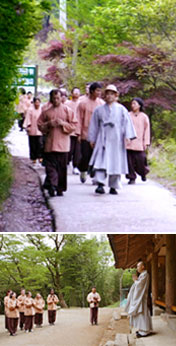
Temple Stay: Temple Tour
View and Read More
A large number of Korea's cultural assets are Buddhist in nature - more than 65% in fact. Buddhist temples are among the most impressive and comprehensive of these assets, preserving a variety of national cultural assets such as architecture, sculpture, crafts and paintings. These represent religious and artistic creations spanning from the 7th century in the Three Kingdoms Period through the Joseon Dynasty, which ended in 1910.
Temples utilize and display traditional architecture, and house and utilize other historical assets like paintings, Dancheong (Buddhist ways of coloring), Seungmu (Buddhist dancing), and Bumpae (Buddhist music). Korean traditions are maintained by temples as living arts.
Most Korean temples are located deep in the mountains. This is a unique aspect of Korean Buddhist culture. Temples blend harmoniously with their natural environment, enhancing the landscape and embodying serenity. One can feel at peace in such a place, and also experience traditional Korean culture at these sites.
Wednesday, October 27, 2010
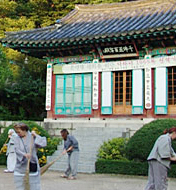
Temple Stay: Daily Rites -- Ulyeok (Community Work)
View and Read More
Ulyeok means residents in the temple all work together. Ulyeok represents Korean Seon tradition well. One rule of Seon is a day without work is a day without food. All Korean temples keep this rule, and it is not merely an admonishment, but in the self-sufficient life in a remote Buddhist temple it is an axiom of practicality.
Normally Ulyeok starts after breakfast, and may include farming, cleaning the living quarters or sweeping the courtyard. This is not just physical work, but should be seen as another way of practicing and developing patience and discipline. While not as intensive as Seon meditation, the rhythmic routine of basic work affords a strong foundation for the monks' daily practice.
Also, after meditating, reading sutras, and worship, monks find Ulyeok relaxing. Sweeping autumn leaves from the courtyard or snow from the pathways provides an opportunity to relate quietly with nature and with each other in the community of work. Taking part in Ulyeok is a way for visitors to express gratitude to the hosts, and to join in an important daily ritual.
Sunday, October 24, 2010
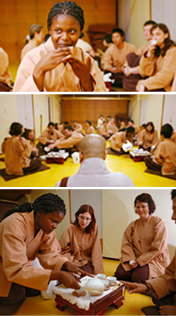
Temple Stay: Daily Rites -- Dado (Tea Ceremony)
View and Read More
Making and enjoying good tea is one of the practices of the Buddhist religion. Koreans say that there are several ways to enjoy good tea. One should start off by enjoying the sounds of water boiling, and then relaxing with the soothing aroma of tea and seeing its soft and subtle colors. Lastly, one can feel the warmth of the tea radiating through the cup as they slowly savor the taste.
The Korean tradition of drinking tea features neither the formality of Japan nor the popular daily routines of China and the West. It is somewhere in between, with the freedom of being neither totally monastic nor totally secular.
For centuries, Seon meditators have enjoyed tea drinking as a means of reflecting upon themselves, nature, and the principles of the universe. Predecessors have said that tea drinking affords the opportunity to quietly appreciate the tea fragrance, color and beauty; and by striving for truth in this, tea drinking can lead one to the world of enlightenment, thereby making the concentration in tea drinking a form of Seon in itself. This gave rise to the saying, "Seon and tea are the same flavor."
Wednesday, October 20, 2010
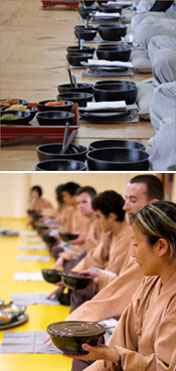
Temple Stay: Daily Rites -- Balwoo-gongyang (Communal Buddhist Meal Service)
View and Read More
Even taking a meal is part of a monk's religious practice. Before eating, a monk thinks in gratitude of the countless number of people who were involved, directly or indirectly, in the production, processing and preparation of the meal. He also thinks of the endless number of beings suffering from hunger and starvation. And he thinks of the equality and harmony of the community of monks he is sharing the meal with. The true Korean Buddhist meal offering (Balwoo-gongyang, literally "Bowl Offering") is one in which the participant strives to keep in mind the law of interdependence of everything and, consequently, great compassion for all sentient beings.
The meal offering is conducted in the half-lotus position and in total silence, without even the wooden spoons and chopsticks making a sound, and not a single grain of rice is wasted. There is no talking, with the monks chanting being the only words uttered in this stirring ritual.
Sunday, October 17, 2010
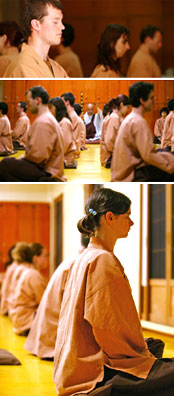
Temple Stay: Daily Rites -- Seon (Zen) Meditation
View and Read More
Seon is a form of meditation similar to Zen that allows a person to reflect on oneself. Korea is renowned for retaining this outstanding meditation tradition that continues to flourish today. Korean Buddhism proudly continues the meditation tradition with two 3-month intensive retreats, one in the summer and one in the winter.
All Buddhist traditions include some form of meditation, and Seon is way to practice meditation in Mahayana Buddhism. This meditation brings an end to the 'monkey mind' that we all experience so that our minds become clear and we can return to our original self. There are many other terms for this return to the original self, including enlightenment, awakening, and realizing one's Buddha nature.
Thursday, October 14, 2010
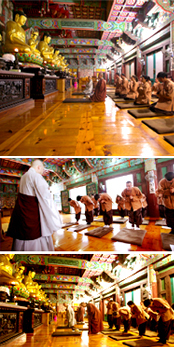
Temple Stay: Daily Rites -- Yebul (Pre-dawn Ceremony)
View and Read More
In the pre-dawn darkness, the gentle, rhythmic sound of the Moktak (wooden gong) and the chants of a monk break the silence, awakening everyone within the temple grounds. The melodic chanting is followed by the playing of four larger percussion instruments - the drum, the wooden fish, the cloud gong, and the large bell.
Then, after everyone has filed into the Main Buddha Hall, the pre-dawn homage service begins - chanting to the Buddhas, Bodhisattvas and Predecessors. This ritual has been performed daily in Korean temples for as long as can be remembered. The sound of chanting echoing in the halls of large temples is particularly moving.
Monday, October 11, 2010
What is a Temple Stay?
View and Read More
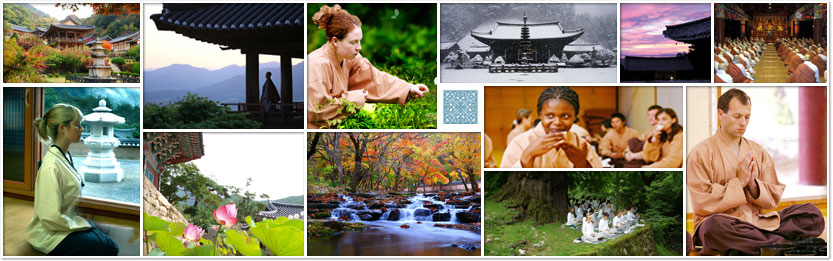
Temple stays are a unique opportunity for foreign tourists to live in a Buddhist temple and learn about and experience Korean Buddhist culture firsthand. Most temples are located deep in the mountains, so visitors can also fully enjoy the beauty of nature. Through spiritual training such as Seon (Zen) meditation and Buddhist rites, guests achieve the kind of peace of mind that is so needed in the modern world. A temple stay is an enriching experience that recharges the soul and spirit, eases stress, and teaches visitors about traditional Korean Buddhist culture.
The basic program at a temple includes Buddhist rites, Seon meditation, tea ceremonies, and Balwoo-gongyang (Buddhist meal with traditional wooden bowls). There are many other activities to participate in, such as lotus lantern making, impression making with ink and paper, and Buddhist beads threading.
.jpg)
Friday, October 8, 2010
Temple Stay - a spiritual journey in search of serenity
View and Read More
Is your everyday work tough to breathe? Come to Korea and stay in the most beautiful temples in the world. You will find peace of mind and let the stresses of modern life melt away.
Monday, October 4, 2010
Korea Tour
View and Read More
We just launched new tour page on our site. Visit and enjoy this beautiful "land of morning calm," Korea!
Saturday, September 11, 2010
Lacquered wooden tray inlaid with mother of pearl bat design

View More Pictures
Produced after an arduous, time-consuming creating process made only by hand, this octagonal lacquered wooden tray inlaid with mother of pearl bat design exhibits the amazing craftsmanship and artistry of Korean mother of pearl crafts.
The houseware coated with natural lacquer has long been used in East Asia for its glossy beauty as well as its practicality for being strong, watertight and antibacterial.
Thursday, September 9, 2010


Monday, September 6, 2010
Final Drying -- How to create a lacquered wooden tray inlaid with mother of pearl bat design

Seventh drying is the final drying. The artist dries the tray on the wooden drying rack in the shade for a day. It needs a special facility for best drying. The drying house has to be a half-sealed room with no dust at all for drying evenly over the entire surface.
Thursday, September 2, 2010
Sixth Lacquering and Drying -- How to create a lacquered wooden tray inlaid with mother of pearl bat design

Friday, August 27, 2010
Inlaying Mother of Pearl -- How to create a lacquered wooden tray inlaid with mother of pearl bat design

Monday, August 23, 2010
Wet Sanding -- How to create a lacquered wooden tray inlaid with mother of pearl bat design

Thursday, August 19, 2010
Third Drying and Sanding -- How to create a lacquered wooden tray inlaid with mother of pearl bat design

Sunday, August 15, 2010
Filling Cracks -- How to create a lacquered wooden tray inlaid with mother of pearl bat design


Thursday, August 12, 2010
Second Sanding and Lacquering -- How to create a lacquered wooden tray inlaid with mother of pearl bat design

Tuesday, August 10, 2010
First Drying -- How to create a lacquered wooden tray inlaid with mother of pearl bat design

Monday, August 9, 2010
How to create a lacquered wooden tray inlaid with mother of pearl bat design -- First Lacquering

Saturday, August 7, 2010
How to create a lacquered wooden tray inlaid with mother of pearl bat design

From today, I will post the process of creating a wonderful wooden tray inlaid with mother of pearl bat design.
It starts with plain wooden tray early made for this. It's uniquely designed octagonal tray. First job is rubbing the surface smooth with sandpaper.
Thursday, July 1, 2010
The Elegance - Haegeum (Korean two-stringed vertical fiddle) Solo by Noh Eun-Ah
Listen to Samples
This album presents original pieces of music presenting the unique tune of Haegeum through the authentic performance by Noh Eun-Ah. Haegeum is a Korean traditional two-stringed vertical fiddle which is one of the representative string instruments used in many traditional Korean musical genres. Each piece features the wonderful harmony between Haegeum's distinctive tone and the melodious background music of western instruments.
.jpg)
Wednesday, October 22, 2008
The Labyrinth: Hwang Byung-Ki Gayageum Masterpiece Vol. 3
Listen to Samples
This album features original pieces composed and performed in 1960's and 1970's. They were considered as one of the most progressive Korean contemporary music. Especially "The Labyrinth" performed with Hong Sin-Cha, an internationally acclaimed, avant-garde artist and choreographer, made a great impact on Korean music world.
.jpg)
Saturday, September 6, 2008
Poongjuk - Korean Tea Ceremony Music
Listen to Samples
This album features original solo pieces composed for tea ceremony played with various Korean traditional musical instruments such as Daegeum (large bamboo transverse flute), Danso (notched vertical bamboo flute), Tungso (notched end-blown vertical bamboo flue), Piri (Bamboo Oboe) and Sogeum (small bamboo transverse flute).
.jpg)
Thursday, August 14, 2008
Dance - Trio and Quartet for Gayageum, Haegeum and Piri
Listen to Samples
This album features original trio and quartet pieces composed by Park Bum-Hoon for representative Korean traditional musical instruments such as Gayageum (Korean traditional zither), Haegeum (Korean traditional two-stringed vertical fiddle) and Piri (Korean Bamboo Oboe).
.jpg)
Sunday, July 6, 2008
Yeo-Chang Gagok by Yi Jun-Ah
Listen to Samples
This album leads to the wonderful world of Gagok, a traditional Korean vocal music. Gagok is a representative vocal genre appreciated by the scholars of the Joseon period (1392-1910). It uses Sijo, traditional Korean poetry with fixed forms, for its texts. Accompaniments and interludes are played by a small ensemble of traditional Korean musical instruments. Performed since around 16th century, Gagok has been passed on until today, undergoing many changes and generating variations.
Gagok has two kinds of modes, the Gyemyeon mode (Gyemyeonjo) and the U mode (Ujo). The former and latter are each compared to the major and minor scale respectively. In addition to the two modes, Ban-U-Ban-Gye, which begins in the U mode but modulates to the Gyemyeon mode, is used. Also, there are 26 pieces for men and 15 for women.
The texts of the male songs (Nam-Chang) are generally masculine and animated. Also, unlike the female songs, male songs are sung only in natural voice and not in falsetto. The texts of the female songs (Yeo-Chang) are usually feminine and sad. Unlike male songs, the female songs use both natural voice and falsetto.
.jpg)


