


View More Pictures

Free Listen
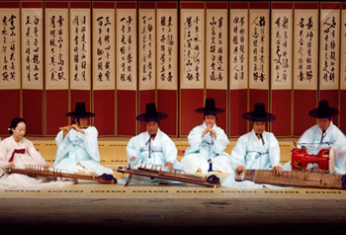
Diverse and rich, Korean traditional music expresses an optimistic spirit that transforms sorrow and despair into excitement and delight.
View More Pictures
This rare black jade necklace and earrings are elaborately carved into a three-layered flower of intricate beauty. It's created by the master of jade sculpture in Korea, Ju-won Jang. The richness and depth of the color adds a wonderful mysteriousness to this beaded jade necklace and earrings. Wearing a natural jade, known to hold the energy of both heaven and earth, ornament near one's heart expresses the sophistication and style of the wearer while positively affecting human energy.
View More Pictures
We can create your own business card holder with your name or company logo with unique mother of pearl design. The elaborate adornment with the iridescence of mother of pearl design will make it an impressive personalized item for you. The embossed lattice pattern on the backside and inside surface, which helps prevent slipping, adds beautiful panache to this business card holder. Please send us your name or company logo as a jpeg or gif file.
View More Pictures
We can create your own business card holder with your name or company logo with unique mother of pearl design. The elaborate adornment with the iridescence of mother of pearl design will make it an impressive personalized item for you. The embossed lattice pattern on the backside and inside surface, which helps prevent slipping, adds beautiful panache to this business card holder. Please send us your name or company logo as a jpeg or gif file.
View More Pictures
There are three famous tea gardens in Korea where the best quality green teas are produced. The gardens are located in Boseong, Hwagae, and Jeju. The gardens in Boseong and Jeju are large and usually produce industrialized green teas. This herbal green tea from the Hwagae is cultivated on privately owned tea gardens located on the southern slopes of Jirisan Mountain, the most remote area from civilization in Korea, and are handmade, therefore producing more delicate teas which are of course, more expensive. Instead of the large breath taking plantations, the tea gardens of Hwagae are smaller in size and the tea trees lay closer to the ground and grow naturally, and are therefore also called "wild green tea."
How Korean Green Tea Different From
While internationally Chinese and Japanese teas are more widely known, Korean green tea is very different from them. And unlike black teas, which are fermented and oxidized before they are dried and shaped, Korean green tea is heated on an iron pot within a few hours of being picked, then rolled by hands and naturally dried in the shade. This allows for the tealeaves to infuse clear light liquids, which have a delicate and subtle flavor.
How to Brew a Cup of Korean Green Tea
There are a few prerequisites to a good cup of green tea, and everything from the quality of water and tea, and the temperature of the water, to when the tea is added to the pot, or how long the tea is steeped, can influence the final result.
When preparing tea for drinking, oolong teas are made using hot water, while that used for black tea should be virtually boiling. The water used for green tea should be much cooler, never more than 80 degrees Centigrade (176 degrees Fahrenheit). For high quality green tea, it is important to steep the tea in water that is about 50-60 degrees Centigrade (122-140 degrees Fahrenheit). This is to suppress catechin and activate the amino acids that are the key to green tea's refreshing taste. Generally, low grade quality green tea (most of tea bags) should be steeped in water that is heated to 70-80 degrees Centigrade (158-176 degrees Fahrenheit); this is lower than other teas, so as to minimize its bitter taste. If the water is too hot, or is allowed to remain too long on the leaves, the finest taste is lost and the bitter elements emerge. When preparing tea, add 50 cc of water (it should be boiled and then cooled to 50-60 degrees Centigrade) to 2 grams of tea per person, and let it sit for 1-2 minutes before drinking.
In order to prepare green tea in Korean way, we use a tea set usually consisting of a tea pot, three or five cups that are smaller than the English variety but larger than the little Chinese ones. In addition there is a large bowl for cooling the boiled hot water, with a lip for pouring the cooled water into the empty pot. The water in this large bowl is also used for warming the pot and cups before placing tea.
How to Serve and Drink Korean Green Tea
Dado is a Korean word literally meaning "the way of tea" or tea ceremony or more loosely etiquette involved when formally drinking tea. At first the different steps may seem complicated, but it does not take long to master them and to drink tea, alone or with others, to become a part of life. When one experiences this ceremony, one can fully understand that this ceremony is not for a show, and not that complicated and rigid as Japanese one, as Koreans feel that it is very important to remain natural while drinking tea together, although dado was also developed to help meditate and cleanse one's mind of needless thoughts. It is a way to enjoy all the pleasures the tea gives.
The process of pouring water and placing tea into a teapot is known as tooda. The placement of tea, depending on the order in which the water and tea are placed, can be known as upper placement, middle placement, or lower placement. In upper placement, the water is poured and then the tea is added. In middle placement, the water is poured halfway and then the tea is added, after which more water is poured. For lower placement, the tea is placed first and the water is then poured on top; this method is deemed more appropriate in the winter. In the summer, upper placement is preferred, whilst middle placement is suitable for the spring and autumn.
The first serving of a new batch of tea is poured directly into the cups, a little at a time, back and forward three times until the cups are filled, in order to spread equally the stronger tea that emerges from the bottom of the teapot. No water must remain in the pot, or it would develop the bitter taste that is so undesirable.
Korean green tea is usually drunk holding the cup in both hands. The first step is to view the color of the tea, the second to inhale its fragrance, the third to taste it on the tongue, the fourth to follow its taste in the throat, and finally there is the lingering aftertaste in the mouth to be enjoyed.
The water for the second and following cups can be a little hotter than that used for the first. The leaves having softened, the water needs to stand on them for only a very short moment, and then the tea is poured into the lipped bowl, which is passed around people serving themselves directly. This avoids passing cups back and forward. Ordinary green tea will usually have lost most of its flavor after serving three times, but very good tea may be used to make four or five rounds. The used tea leaves can be employed in a variety of ways: in cooking, in bathwater or as a hair-rinse, or to remove the smell from a refrigerator, etc.
Green Tea Health Benefits
Green tea has high contents of vitamin C, catechin and amino acids, all substances that for many years have been known to be great for your skin. Green tea is also a low-calorie drink and would be helpful for those trying to lose weight. Recently, "Yale University researchers detail the body of evidence linking green tea to better heart health and a lower risk of cancer (Reported by MSNBC)."
View More Pictures
The wooden geese are used even after they got married. They are used as a means of nonverbal communication between the couple. If the female goose turns her back as in this picture, it means the wife is sulky and doesn't want to talk to the husband.
View More Pictures
A couple of wooden geese is used in Korean traditional wedding since they symbolize a happily married couple who remains faithful to their partner their entire lives.
View and Read More
Korea has the largest concentration of dolmens in the world. These incredible Megalithic funerary monuments were constructed by prehistoric peoples over 3000 years ago.
The prehistoric cemeteries at Gochang, Hwasun, and Ganghwa contain hundreds of dolmens - tombs constructed of large stone slabs dating back to the 1st millennium BC. They form part of the Megalithic Culture found all over the world, but nowhere in such a concentration than in Korea.
The global prehistoric technological and social phenomenon that resulted in the appearance in the 2nd and 3rd millennia BCE of funerary and ritual monuments constructed of large stones is nowhere more vividly illustrated than in the dolmen cemeteries of Gochang, Hwasun, and Gangwha.
Dolmens are Megalithic funerary monuments, which are numerous in Asia, Europe, and North Africa. Korea has the greatest number of any country. The dolmens located in Korea are of great archaeological value for the information they provide about the prehistoric peoples who built them and their social and political systems, beliefs and rituals, arts and ceremonies, etc.
The Gochang, Hwasun, and Ganghwa sites contain the highest number and greatest variety of dolmens in Korea, and indeed around the world. They also demonstrate the extraordinary ability of the prehistoric people 3000 years ago to quarry, transport and raise the stones, as well as how dolmen types changed over time in north-east Asia.
View and Read More
A magnificent stronghold was built by an emperor at the end of the 18th century to house his beloved fathers remains.
When Emperor Joengjo of the Joseon Dynasty (1392-1910) moved his father's tomb to Suwon city at the end of the 18th century, he surrounded it with strong defensive works designed by an influential military architect of the period. He erected massive walls that extended for nearly 6km, bastions and artillery towers, all to protect and honor his fathers remains.
Hwaseong Fortress is an outstanding example of early modern military architecture. Embracing the busy downtown area of the present Suwon city (the capital of Gyeonggi province, some 30km south of Seoul), it embodies Jeongjo's devotion to his father and his ideals for a modern administrative and commercial center with stalwart defense.
Hwaseong Fortress is of magnificent size. It spreads out over a widely changing landscape, from high mountain ridges overlooking a crowded urban center to a flatland park to a bustling marketplace surrounded by a densely populated neighborhood. The fortress looks remarkably different from most other ancient town walls and military fortifications scattered across the country. It is notable not only for its diverse functions but also for its visual originality and technical innovation involved in its design and construction.
Visitors are permitted to stroll along the fortress, and one may imagine the hopes and ambitions of the emperor as he built this magnificent fortification to create a robust city and to shield and shelter his city's inhabitants from invaders. For those who are inclined to historical romance, his tragic childhood experience and his noble affection for his parents adds a remorseful color to the excursion along the stronghold, punctuated with crenels and merlons and highlighted by lofty watch towers and secret gates leading down to dark labyrinths.
View and Read More
Master craftsmen engraved Buddhist texts onto blocks of wood nearly 800 years ago. They have been remarkably preserved, and are in near perfect condition.
The Temple of Haeinsa on Mount Kaya is home to the Tripitaka Koreana, the most complete collection of Buddhist texts in the world. These texts were incredibly engraved on 80,000 wooden blocks nearly 800 years ago during the Goryeo Dynasty, between the years 1237 and 1248. The buildings of Janggyeong Pangeon were built in the 15th century to house the wood blocks. As the oldest depository of the Tripitaka, the Janggyeong Pangeon reveals an astonishing mastery of the invention and implementation of conservation techniques used to preserve these exceptional works of art.
The World Heritage Committee inscribed this site on the World Heritage List because the Tripitaka Koreana is one of the most important and most complete bodies of Buddhist doctrinal texts in the world. In addition, the buildings in which the scriptures are housed are remarkable as they have preserved these ancient wooden texts against deterioration and disintegration due to age, environmental and weather conditions, insects, etc.
Even though nearly 800 years has been passed since the Tripitaka Koreana was carved, the wooden blocks on which the texts are engraved are in near perfect condition. The wooden blocks and the carefully, devotedly engraved words on them illustrate the superior craftsmanship of the artists.
This engraving of Buddhist manuscripts onto wooden blocks is the oldest example of this type of artwork on Earth. Therefore, these teachings are a wonderful example of Buddhist wisdom and knowledge.
At the same time, the Tripitaka Koreana has greatly influenced the early development of printing and publishing around the globe. Thus, the Tripitaka Koreana is a shining example of both the culture of the Goryeo Dynasty and of Buddhist history, both of which have enlightened the world.
View and Read More
The ancient tradition of ancestral worship is perpetuated in modern times through the Royal Tombs of the Joseon Dynasty. Located in areas of sublime beauty, the tombs are sacred structures that inspire devotion.
The Royal Tombs of Joseon Dynasty (1392-1910) are an outstanding example of a type of architectural ensemble that illustrates a significant stage in the development of Korean burial mounds. The royal tombs, with their place in nature and their unique and regularized configuration of buildings and structures, manifest and reinforce the centuries-old tradition and living practice of ancestral worship.
The Royal Tombs of the Joseon Dynasty form a collection of 40 tombs scattered over 18 locations across the country. Built over five centuries, from 1408 to 1966, the tombs honored the memory of ancestors, showed respect for their achievements, asserted royal authority, protected ancestral spirits from evil and provided protection from vandalism. The Joseon Tombs completes the 5,000 year history of royal tombs architecture in the Korean peninsula.
The ensemble of structures that comprise the Royal Tombs features a ceremonial area and an entrance, alongside the burial mounds. In addition, associated buildings that are an integral part of the tombs include a T-shaped wooden shrine, a shed for stele, a royal kitchen and a guards house, a red-spiked gate and the tomb keepers house. The grounds are adorned with a range of stone objects, many featuring figures of people and animals.
The tombs were built in places of outstanding natural beauty, with the back side of the tombs protected by a hill as they face south toward water and, ideally, with mountain ridges visible in the distance.
Within the context of Confucian cultures, the integrated approach of the Royal Tombs of Joseon with nature and the universe has resulted in a distinctive and significant funeral tradition in Korea. The beautiful natural surroundings of the Royal Tombs of the Joseon Dynasty, shaped by the principles of pungsu (feng shui in Chinese), create a delicate, sacred setting for the living tradition of ancestral worship and its associated rites in modern times.
View and Read More
Built in the 16th century, Jongmyo Shrine is a wonderful example of Confucian architecture. Both grand and minimalist, it exudes the dignity and majesty of Koreas deceased kings that it venerates.
Jongmyo is the oldest Confucian royal shrine in Korea and is magnificently preserved to this day. Dedicated to the forefathers of the Joseon dynasty (1392-1910), the shrine was built in the 16th century and houses tablets bearing the teachings of members of the former royal family. Ritual ceremonies linking music, song and dance still take place there, perpetuating a tradition that goes back some 500 years.
In Korean culture (and in many cultures throughout Asia), traditional rites are deemed highly important in modern society to preserve and maintain basic social order. There are a number of important rituals in Korea, the most significant of these being the Jongmyo and the Sajik rituals.
Jongmyo is the term used for a place where memorial services are performed for deceased kings, while Sajik is the term for a place where services for the gods of earth and crops are performed. These symbolic rituals ensure social order and the successful ruling of the nation.
Consequently, due to the significance of these rituals, the Jongmyo and Sajik shrines where these rituals are performed are classic in their architectural grace, detail and beauty. Although such facilities existed in Korea as early as the Three Kingdoms Period (57 B.C.-668 A.D.), those that remain today in Seoul are from the Joseon Dynasty (1392-1910).
Jeongjeon, the main hall, is comprised of 19 identical rooms that are all minimalist in design with no ornamentation. However, the building as a whole is impressive in its grandeur, with 20 thick round pillars boldly projecting the dignity and majesty of royalty. In front of Jeongjeon is a remarkable elevated stone yard called Woldae, which is used during ceremonies by musicians, dancers and other participants. Woldae wonderfully complements the architecture of the main hall, with the large stone blocks comprising the yard creating a striking and solemn atmosphere as they lay in silence before Jeongjeon.
View and Read More
Changdeokgung Palace Complex was built in the 15th century with careful consideration given to its natural surroundings. It is a superb example of a man-made structure blending harmoniously with the beauty of the landscape.
Changdeokgung Palace Complex is an outstanding example of Far Eastern palace architecture and garden design, exceptional for the way in which the buildings are integrated into and harmonized with the landscape, adapting to the topography and leaving the surrounding indigenous trees to grow and flourish in their natural beauty.
During the Joseon Dynasty in the early 15th century, Emperor Taejong ordered the construction of a new palace at an auspicious site, and the Changdeokgung Palace Complex was built. Located in Seoul, it has more structures preserved than any other palace from that period and covers a total area of 580,000 square meters. Consisting of a number of official and residential buildings, the palace complex - including the Secret Garden - was created in a lovely garden space that was cleverly adapted to the uneven topography of the site.
A particularly distinctive feature of Changdeokgung Palace is the fact that it was built with little effect on the natural environment and was designed to be in harmony with nature. Buildings were designed and constructed to blend easily with the immediate surroundings and even directions were given for careful consideration in planning and building. Space was utilized to provide distinctly different yet harmonious views and atmospheres throughout the palace grounds. The result is an exceptional example of Far Eastern palace architecture and design, unifying peacefully with the surrounding landscape.


.jpg)
.jpg)
.jpg)
.jpg)
.jpg)
.jpg)
.jpg)
.jpg)
.jpg)
.jpg)
.jpg)
.jpg)

